Atmosphere, Perception, and the Afghan Church
Phenomenological Reading of the Afghan Church, Mumbai
Phenomenology emerged in the early 20th century with Edmund Husserl, who introduced it as a way of understanding how experiences are perceived and given meaning, without relying on prior assumptions. His student Martin Heidegger expanded this into an existential approach focused on “being-in-the-world” shifting attention from abstract theory to lived human experience. Later thinkers such as Maurice Merleau-Ponty pushed this further by emphasizing the role of the body, showing how space and perception are always experienced through movement, senses, and presence.
In architecture, phenomenology gained importance in the mid-20th century as architects and theorists began to look beyond form and function toward how spaces are actually lived and felt. A key figure here was Christian Norberg-Schulz, whose book Genius Loci (1979) applied Heidegger’s ideas to architecture and argued that buildings should respond to human experience and the specific character of place. Over time, these ideas were developed further in architectural theory and education, connecting philosophical discussions of perception and embodiment directly to architectural design.

AFGHAN CHURCH


Built in the mid-1800s, Mumbai’s St. John the Evangelist church is more commonly known as the Afghan Church due to its function as a memorial for those killed in the Anglo-Afghan Wars. The site is of architectural and historical significance, being the first example of Gothic Revival architecture in all of India. The church and its embellishments were conceived and executed by renowned architects and designers Henry Conybeare, Sir William Wailes and William Butterfield
The experience of the Afghan Church unfolds through a gradual sequence of spatial and atmospheric shifts. Located in Colaba, Mumbai, the church sits within an active urban fabric shaped by traffic, a nearby bus station, and the presence of navy personnel in Navy Nagar. This everyday urban condition heightens the contrast encountered upon entering the church complex.
The building asserts itself immediately. The tall bell tower and beige stone mass appear imposing. The body instinctively slows on approach; scale demands attention before entry. This moment marks a clear separation from the city and signals a transition toward a controlled interior order.
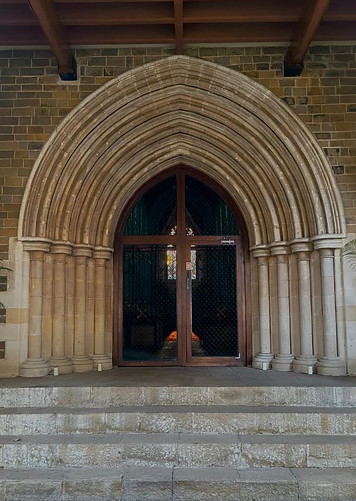
The movement into the narthex introduces a distinct atmospheric change. Light reduces, ceiling height lowers. This semi-open threshold mediates between outside and inside. From here, a strong visual axis is established. The arched entry frames the altar and the stained glass window above it, aligned along the central aisle.
Upon entering the nave, the atmosphere shifts again. Soft, diffused light fills the interior, and the vertical scale becomes immediately apparent. Tall, repetitive columns and arches establish a steady upward rhythm, drawing the gaze away from the ground plane. The body feels small, but not diminished. Above, the wooden roof trusses appear visually light against the heavier stone structure below.
Sound plays a central role in shaping the interior experience. Sounds produced within the church, footsteps, movement, the opening of doors reverberate through the space and lose their point of origin. This acoustic condition instinctively encourages silence. Quiet is not imposed; it emerges as a bodily response to reverberation and scale.
External sounds remain present. Cars passing outside and birds can be heard, including one bird with a soothing whistling call whose source is never visible. The interior visually separates the visitor from the outside world, yet remains acoustically connected to it. The direction of external sounds can still be sensed, while interior sounds dissolve spatially. This contrast produces a subtle loss of control, encouraging stillness and inward focus.

Light further shapes the church’s atmosphere. It enters from the sides and above through clerestory windows, striking interior surfaces with measured intensity. The light is calm and balanced, contributing to the overall sense of stillness. Shifts in brightness occur gradually, keeping the eye engaged without distraction.
The stained glass window above the altar introduces a different quality of light. Its colors appear more vivid and luminous, allowing light to pass through more directly. This window draws attention toward the altar and reinforces the axial order of the space. Other stained glass windows filter light more opaquely, strengthening the visual separation between interior and exterior.
One window, however, remains open. Through it, trees and vegetation are visible. This opening raises a question: how would the interior experience change if more windows were open? Would the light feel harsher? Would attention drift outward, toward the visible landscape or the bird whose call is heard but not seen?
Materiality supports this experiential reading. The stone flooring feels cool and worn, marked by cracks and indentations accumulated over time. Much of it remains concealed beneath benches, reinforcing its secondary visual role. In contrast, the columns appear freshly painted, creating a quiet tension between surfaces that register age and those that appear renewed. Time is sensed through material condition rather than explicit historical reference.
The Afghan Church seems to operate as much through lived experience as through visual form. As one moves through the building, shifts in sound, light, scale, and material subtly register in the body, shaping awareness and inviting moments of pause and quiet. When read phenomenologically, the church may be understood not only as a historical structure, but as a space that continues to allow for silence, presence, and introspection to emerge