Domestic Routine and Lived Space
My house is a standalone bungalow located in Gurgaon, similar in scale and character to many houses across the NCR region. Built shortly after my birth, it is the only home I have known, having housed three generations of my family over the past nineteen years. While the ground floor functions independently as a rental or guest space, everyday life unfolds primarily across the interconnected first and second floors, which form the focus of this essay. These two levels are visually and spatially linked through a double-height lobby and staircase, creating a continuous interior rather than clearly separated zones.

FIRST FLOOR PLAN
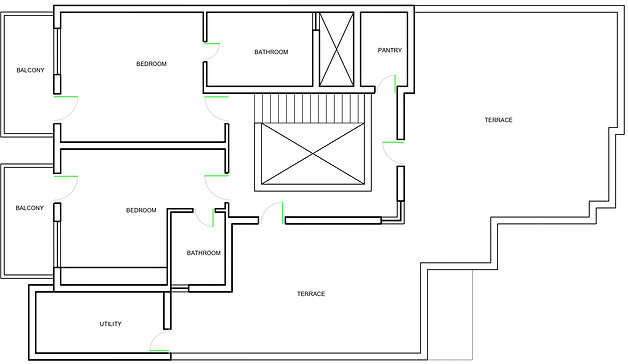
SECOND FLOOR PLAN
Rather than reading the house as a fixed arrangement of rooms, this essay examines it as a structure continually shaped by the daily routines of its occupants. Through repeated patterns of movement, gathering, and withdrawal, spaces acquire specific roles that extend beyond their intended functions.
The day begins quietly. My grandparents, who occupy one of the bedrooms on the second floor, are usually the first to wake. At this hour, the house remains calm and sparsely occupied. Familiar sounds, the morning news playing softly on the television or the clink of a tea glass mark the beginning of daily activity without disturbing the overall stillness. During this time, the central lobby on the first floor is gently lit by north-facing windows. As a double-height space connecting both floors, it remains visually present yet largely inactive, holding a sense of anticipation before the rest of the house wakes.
Soon after, the bai wakes and moves toward the kitchen on the first floor to begin preparing breakfast. With this shift, movement within the house increases. The kitchen becomes the first fully activated space, while circulation paths between the lobby, staircase, and bedrooms begin to overlap. My parents are usually next to wake, using their bedroom on the second floor before moving downstairs for tea. My siblings follow a similar pattern, preparing for the day and gradually filtering through shared spaces. During this period, the house transitions from quiet separation to shared occupation, with the lobby and staircase acting less as destinations and more as connective tissue that allows movement and awareness across floors.
As family members leave for work and daily commitments, the house slowly empties. Activity reduces, and many rooms return to a state of relative stillness. The lobby once again becomes a transitional space, holding light and volume rather than movement. Despite reduced occupation, the house does not feel inactive; furniture placement, open doors, and lingering sounds suggest readiness for return rather than abandonment.
After most family members leave for work, the house takes on a different character. During this period, it is primarily occupied by my grandparents and myself, while the cleaning maid moves in and out as part of the daily routine. My mother, who works nearby, also returns intermittently for lunch before leaving again. As a result, the house is neither fully active nor fully empty, but operates at a slower, more porous rhythm. At this time of day, the interior is flushed with natural light, particularly across the lobby and shared spaces. Activities such as cleaning, resting, and brief moments of interaction occur alongside one another, revealing how the house adapts to varying degrees of presence without requiring any change in spatial organization.
In the evening, the rhythm of the house reverses. Family members return at different times, and the interior gradually fills again. Shared spaces on the first floor, particularly the living room, become sites of convergence. Multiple activities occur simultaneously, conversation, rest, television, and movement, requiring informal negotiation rather than fixed use. The visual openness between the two floors allows sounds and movement to travel freely, reinforcing a sense of togetherness even when occupants are not gathered in the same room.
The house does not maintain a rigid separation between public and private space. While guests are typically received in the living room and use the common washroom, the activation of spaces remains largely unchanged in their presence. The living room, which might conventionally function as a formal or public space, is used by the family every night for dinner, blurring distinctions between hosting and everyday living. Circulation routes, shared amenities, and visual connections remain common, allowing the house to function through routine rather than controlled zoning.
This lack of segregation extends to the organization of private spaces. Bedrooms across the house are similar in size and access, including the room occupied by the bai, who lives and works within the household. Rather than being defined through hierarchy, privacy within the house is achieved largely through timing and habit. Rooms shift between shared and private use depending on the hour, while quieter moments are found during periods of reduced occupation rather than through strict enclosure.
Read through the lens of daily routine, the house emerges not as a static structure but as a framework continually shaped by lived patterns. Movement, overlap, and repetition give meaning to its spaces, revealing how architecture is produced through everyday life rather than design intent alone.